01 · Introduction
Purchase requests,
done right.
ProcureAI is an AI procurement assistant for large GCC enterprises. It helps employees turn a purchasing need into a compliant, approval-ready request.
Describe the need in plain words, get only approved suppliers, compare quotes with the evidence in view, fix policy issues before submitting, and always know who has the request.
02 · Problem & approach
Procurement is built around policy. Requesters aren't.
Large GCC enterprises run purchasing through approved vendor lists, delegation-of-authority matrices, quotation thresholds and local-content rules. The tools behind it are built for procurement specialists.
The person raising the request is often a team lead who buys a few times a quarter. They know what they need, but not the policy or the ERP terms, so requests bounce back and forth.
Our goal: help occasional requesters turn a business need into a compliant, approval-ready request, with AI guidance they can understand, question and override.
Requests arrived incomplete
Forms mirror back-office data models, so people leave out specs, dates and cost centres, and Procurement sends them back.
Solution · The requester describes the need in their own words. AI drafts the fields from the IT standard and past orders, and asks only the questions it could not infer.
Nobody knew who they could buy from
Approved suppliers, framework contracts and registration status live in different systems, or with individual buyers.
Solution · Supplier discovery shows approved suppliers only by default, with contract, lead time and on-time record on each row, and checks the three-quotation rule live.
Choosing a quote felt risky
Quotes arrive as PDFs, emails and spreadsheets. The requester carries the accountability with no clear criteria.
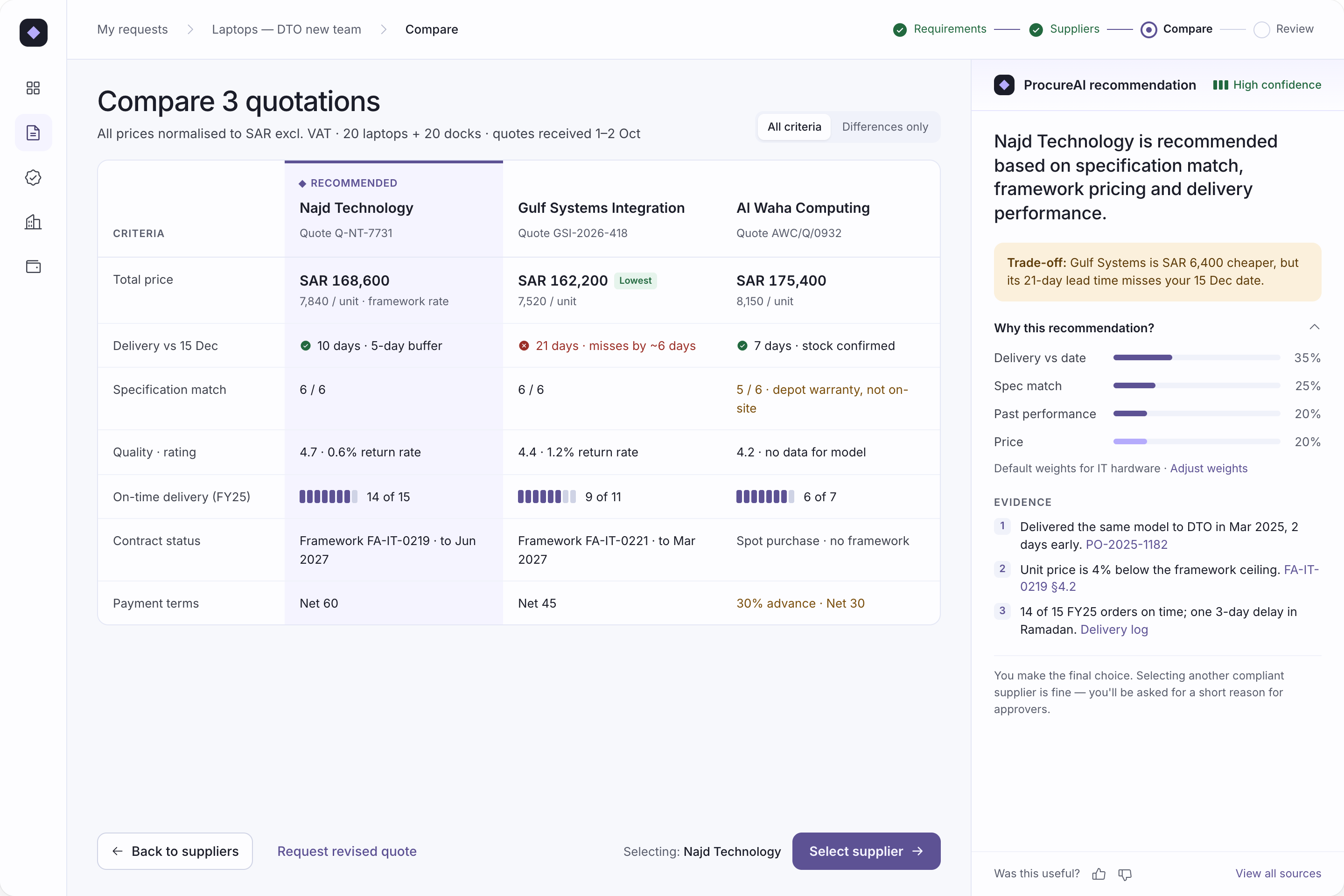
Solution · Quotes are normalised to SAR excl. VAT side by side. The recommendation leads with its reason, states the trade-off, and links every claim to a source.
Policy surprises came too late
Budget, document and approval-route issues were found by reviewers after submission, and status was chased by email.
Solution · Eleven checks run before submission in plain language, with fixes in place. After submitting, tracking leads with who has the request and when it will be done.
03 · Project map
Workflow
Some steps share a screen: requirements are pulled out and edited in one place, the recommendation sits inside the comparison, and budget and policy are checked in a single review.
04 · Mockups
8 screensScreens
Scenario: a Programme Lead in a Riyadh holding group requests 20 developer laptops for a new team. All names, suppliers and figures are illustrative.
Start and describe
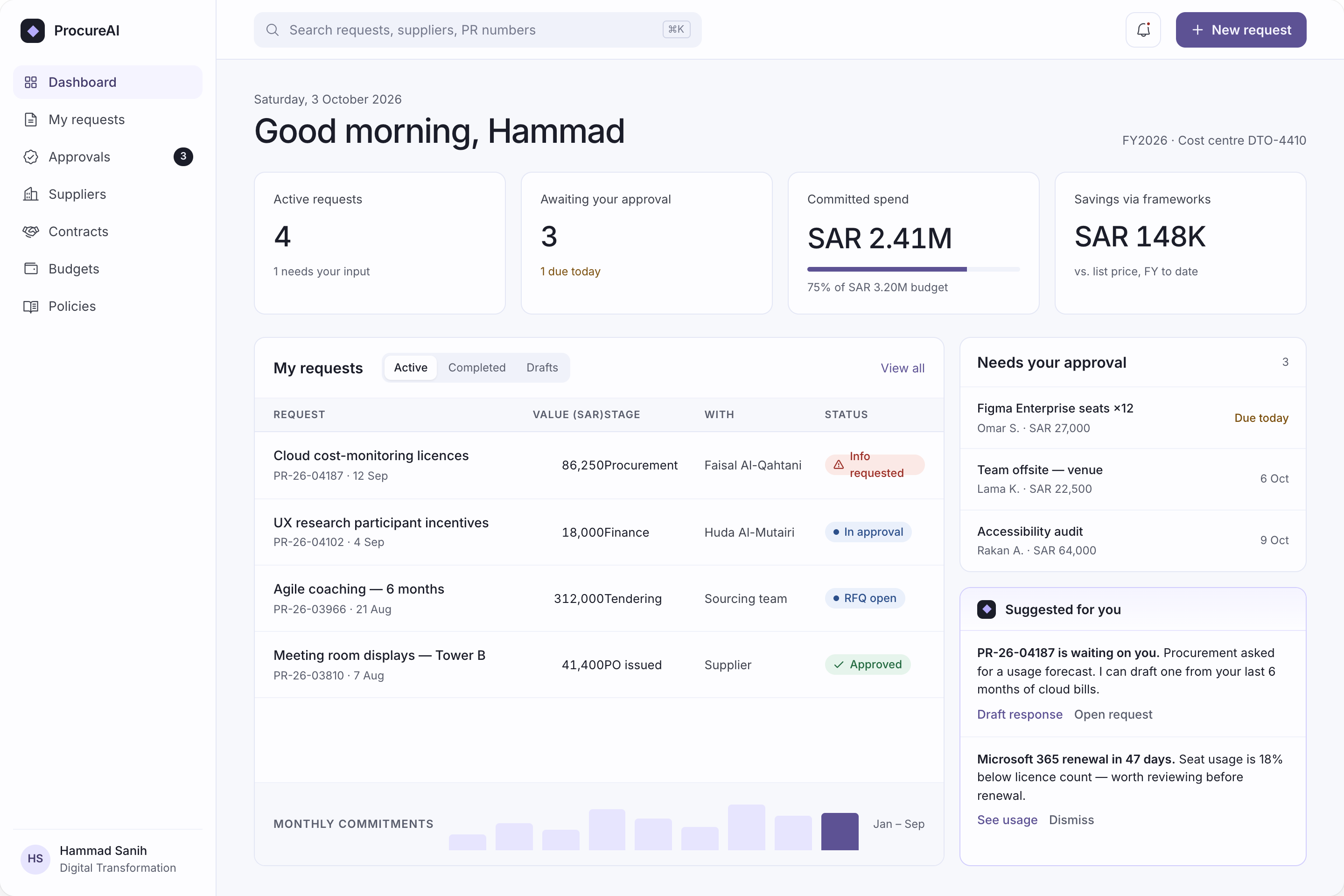
01 – 02What needs me, what is moving and where to start. AI nudges flag stalled requests and renewals without taking over the page.
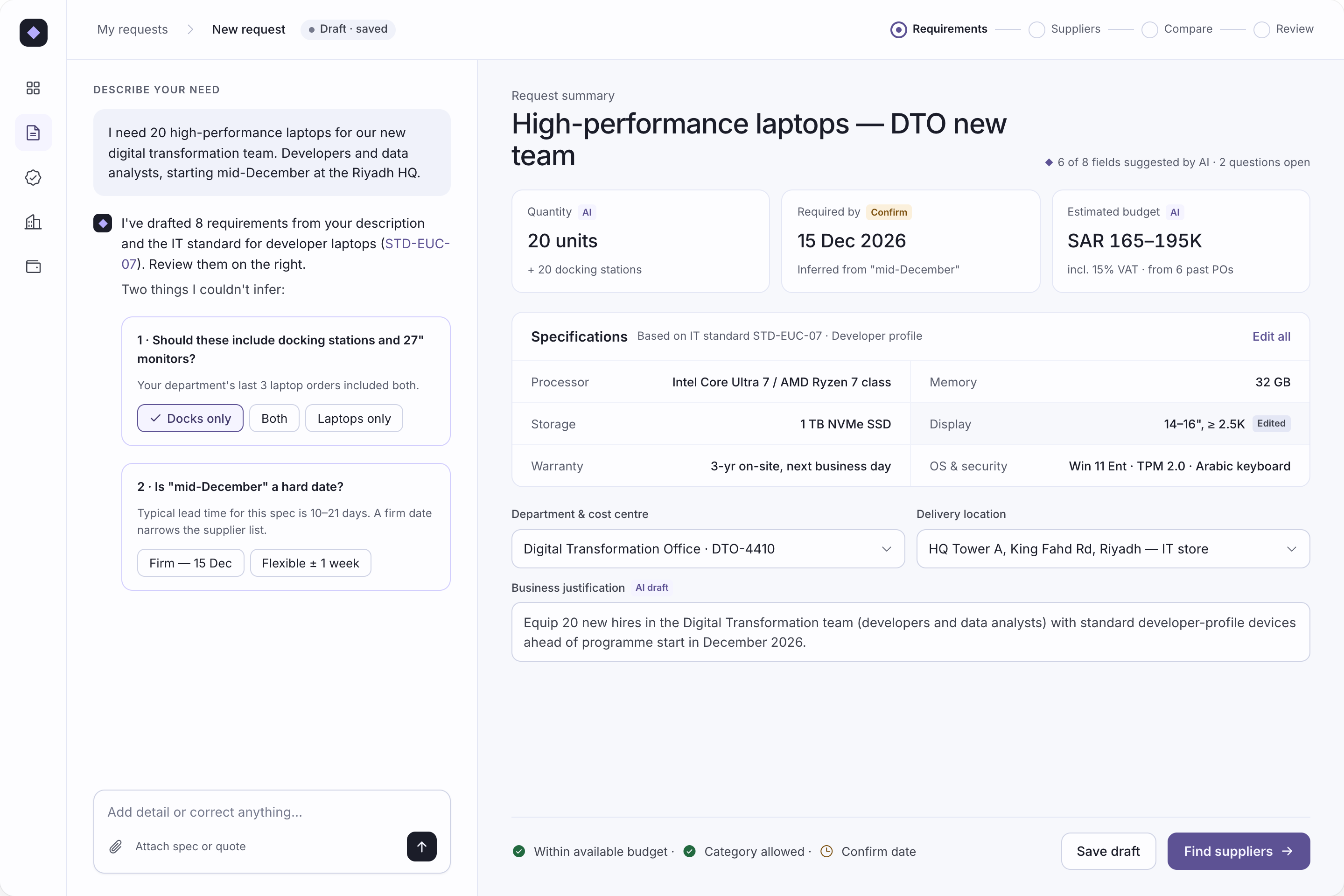
The user describes the need in a chat, and the structured request fills in alongside it. Every AI-filled field is marked and editable, and only two questions are asked.
Find and compare
03 – 04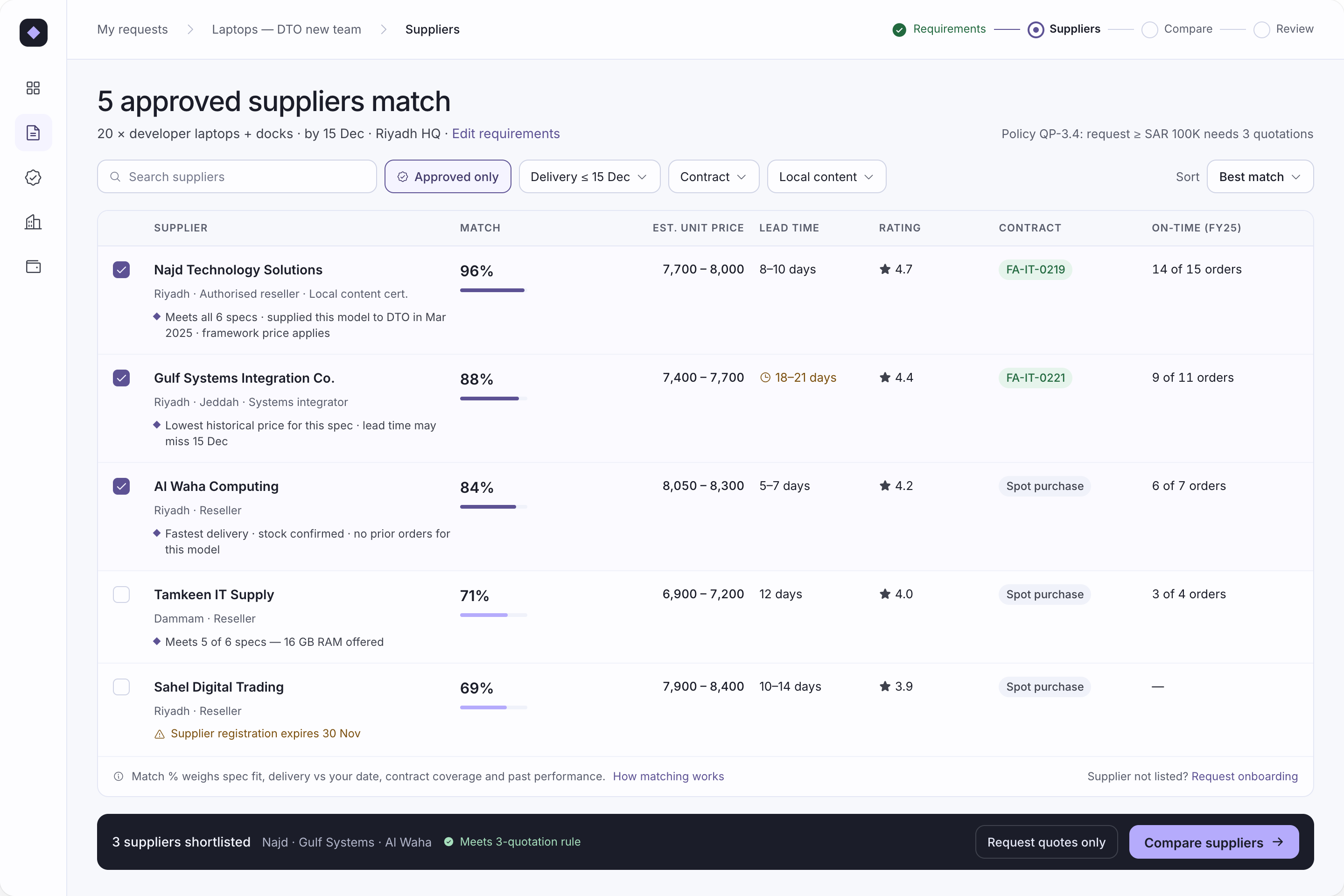
Approved suppliers only by default. Each match explains itself, and the shortlist bar confirms the three-quotation rule is met.
Criteria rows, supplier columns and an explainer rail. The pick is not the cheapest, and the trade-off says so up front.
Comparison directions
04b – 04c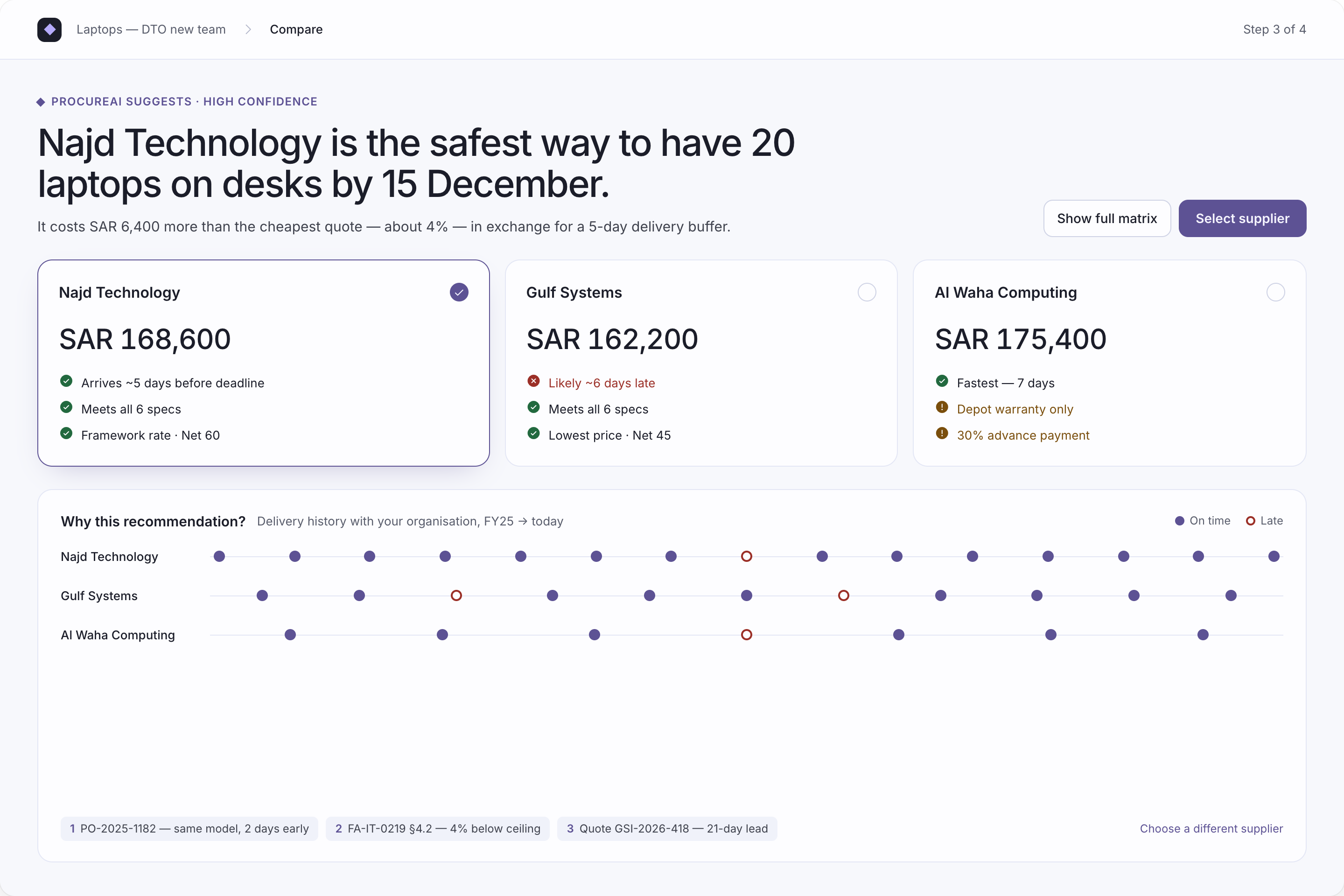
An alternative that leads with the verdict, then supplier cards with delivery history as the evidence.
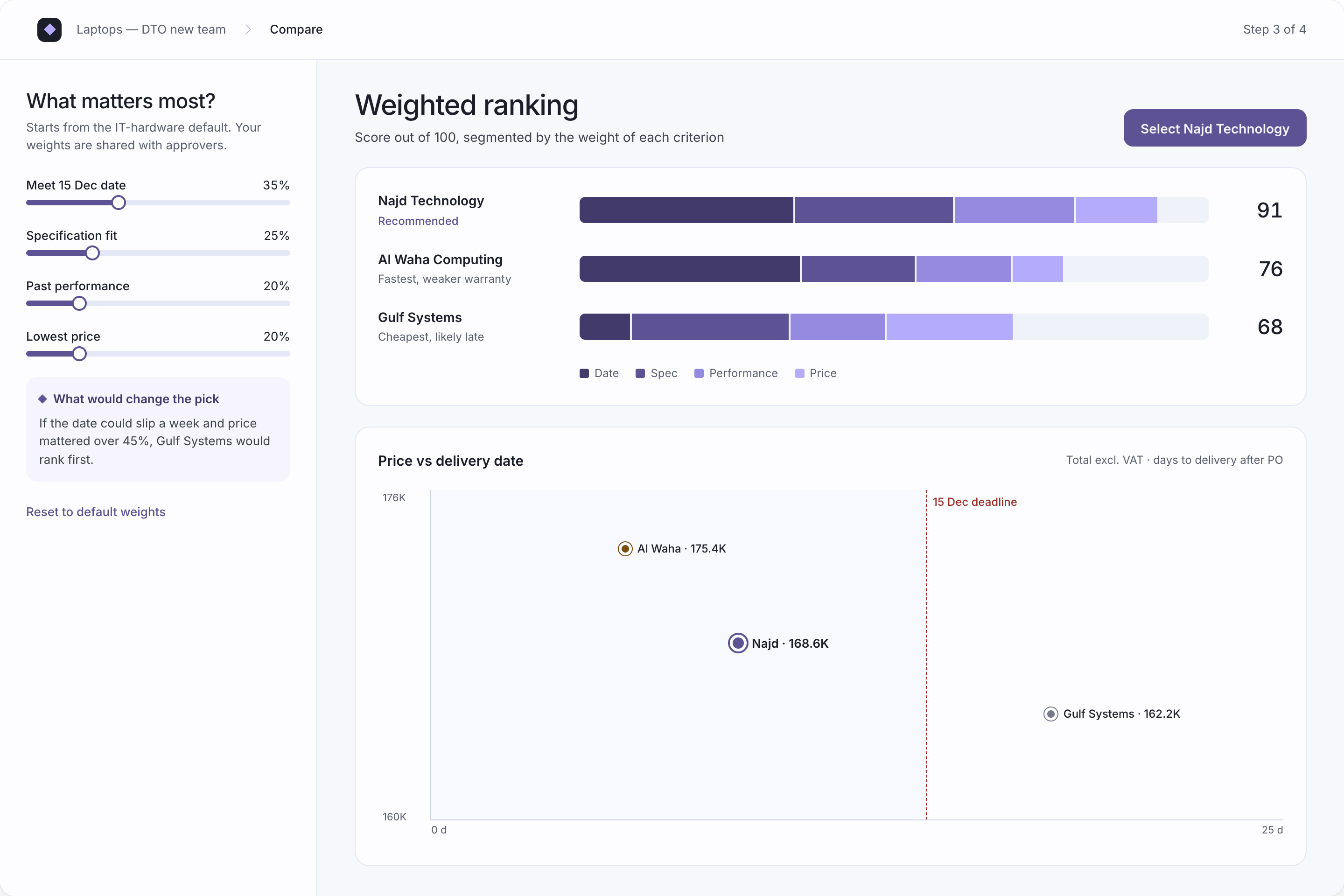
The user sets the weights and the AI re-ranks, then says what would change its pick.
Submit and track
05 – 06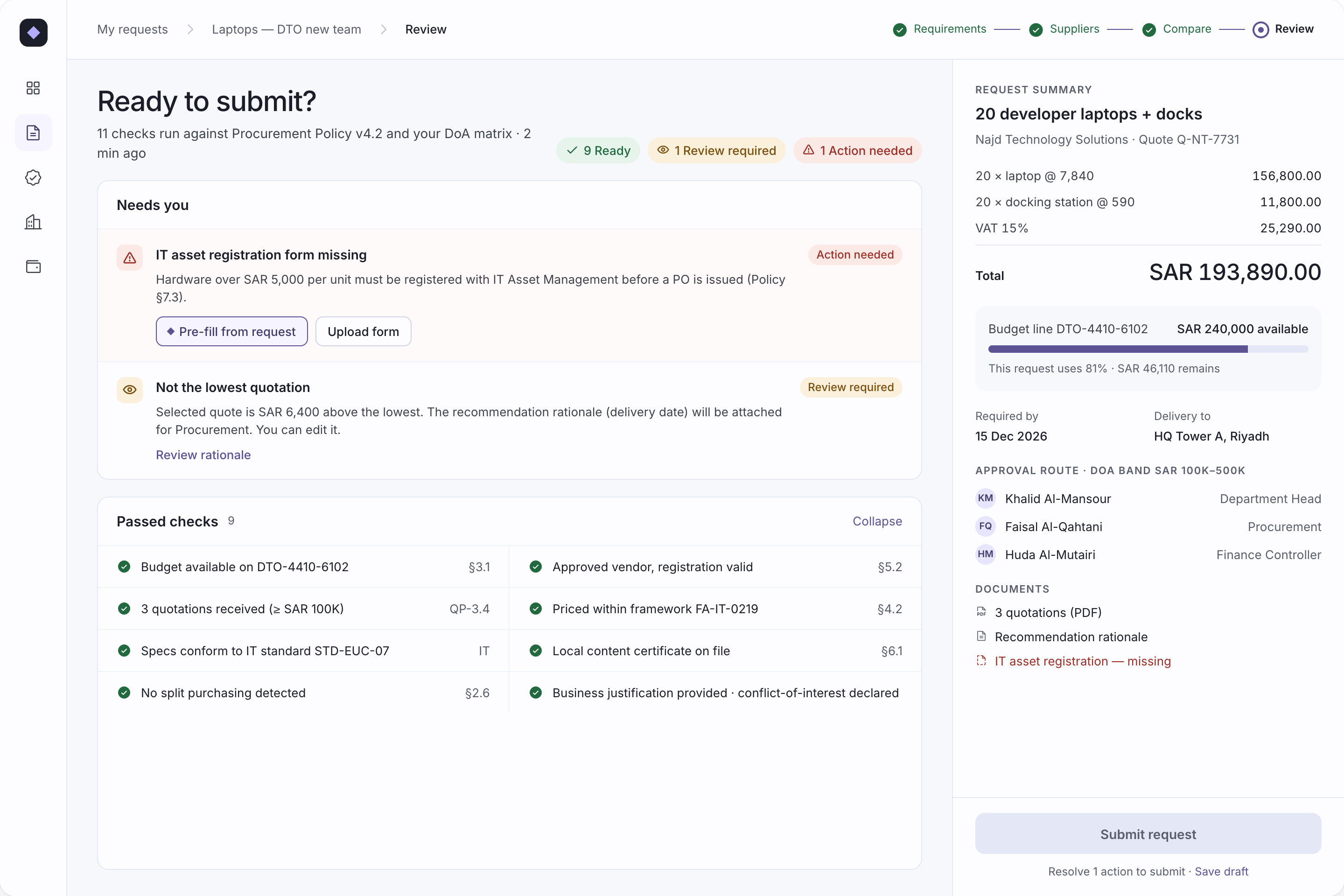
Eleven checks against policy and the approval matrix, in plain language. The one blocker can be pre-filled from the request.
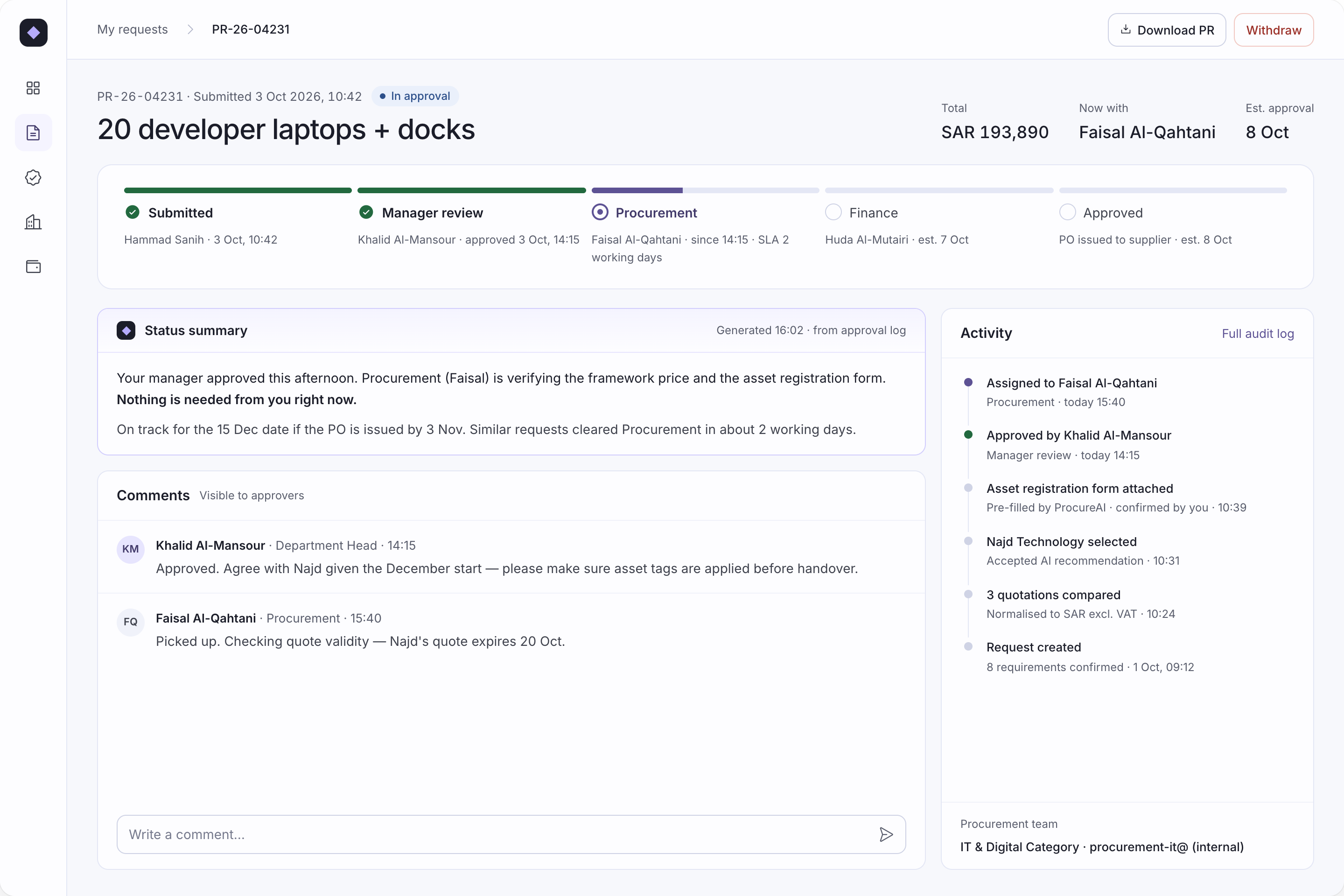
Leads with who has it and when it will be done. An AI status summary says whether anything is needed from you.